

by Daniel Parra
Families will be eligible for a supplemental payment this fall if they received the Empire State Child Credit when they filed 2023 tax returns. However, experts say the formula used to calculate payments is inequitable and excludes the lowest-income families from the maximum credit.
The recent unveiling of the $237 billion New York State budget has stirred controversy, particularly around tenant stability and environmental issues. And local advocates are adding another item to this list of budget disappointments: a chance to cut child poverty in New York.
While this year’s budget deal includes approximately $350 million for supplemental payments under New York’s Empire State Child Credit (ESCC)—for which families with mixed immigration status and Individual Taxpayer Identification Number (ITIN) filers may be eligible—it left out a more expansive plan that many anti-poverty advocates had been pushing for.
That proposal would create a new Working Families Tax Credit to replace the ESCC, offering households a minimum $500 credit per child regardless of income level (as compared to the current ESCC, under which the maximum credit a one-child household can earn is $330).
Still, advocates welcomed the $350 million allocation as good news, because families in need will receive money in the fall. A similar supplemental ESCC payment was included in the 2022-2023 budget.
“The supplemental payment was the way that they could say, ‘We are still going to include something for families in this budget,’” Liza Schwartzwald, director of economic justice and family empowerment for the New York Immigrant Coalition, said on April 19, as details of the budget agreement were being finalized.
A quarter of the city’s children lived in poverty in 2022, as did 23 percent of adults, according to a Robin Hood report—doubling the national poverty rate of 12 percent. That’s an increase of nearly 500,000 people from 2021, an uptick researchers attributed to the end of pandemic-era public benefits.
During late budget negotiations in Albany, poverty experts and advocates learned that no permanent changes to family tax credits would be included. Instead, legislators were considering an ESCC supplemental payment, which had been included in the Assembly’s one-house budget proposal.
For distributing the supplemental payment, the Assembly had proposed an option (illustrated by the orange line in the chart below) that increased or decreased based on income. But advocates put together an alternative they argued would be more equitable: a flat payment to all families earning roughly $80,000 or less, with reduced payments for higher earning families proportional to their income (illustrated by the blue line in the graph below).
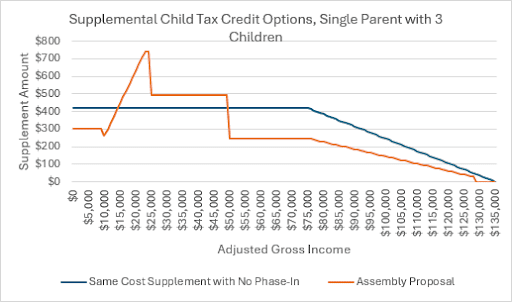
That option “is probably the more understandable of the two when it comes to families, and the one that would have the higher impact on poverty reduction,” said Schwartzwald. That’s in line with the state’s commitment to reduce child poverty by 50 percent over 10 years, passed as part of the Child Poverty Reduction Act in 2021.
However, the final budget included the Assembly’s distribution plan, which comprises only a one-time payment that varies significantly—and, in the opinion of several experts and advocates, arbitrarily—based on income, with payment ranging from 25 to 100 percent of credit they received with their 2023 taxes.
In addition, it excludes the neediest families from earning the highest possible credit due to a “phased-in” income requirement the ESCC inherited from the federal Child Tax Credit, critics say.
The phase-in component means that “no family earning below $9,667 per year can receive the full credit,” complained Pete Nabozny, policy director of The Children’s Agenda. “Families with multiple children do not receive the full credit until their income is much higher.”
As part of the New York State Child Poverty Reduction Advisory Council (CPRAC), researchers with the Center on Poverty and Social Policy at Columbia University made seven recommendations for changing the ESCC, including eliminating the phase-in component.
Read the full article for more data and analysis about solutions that would work…